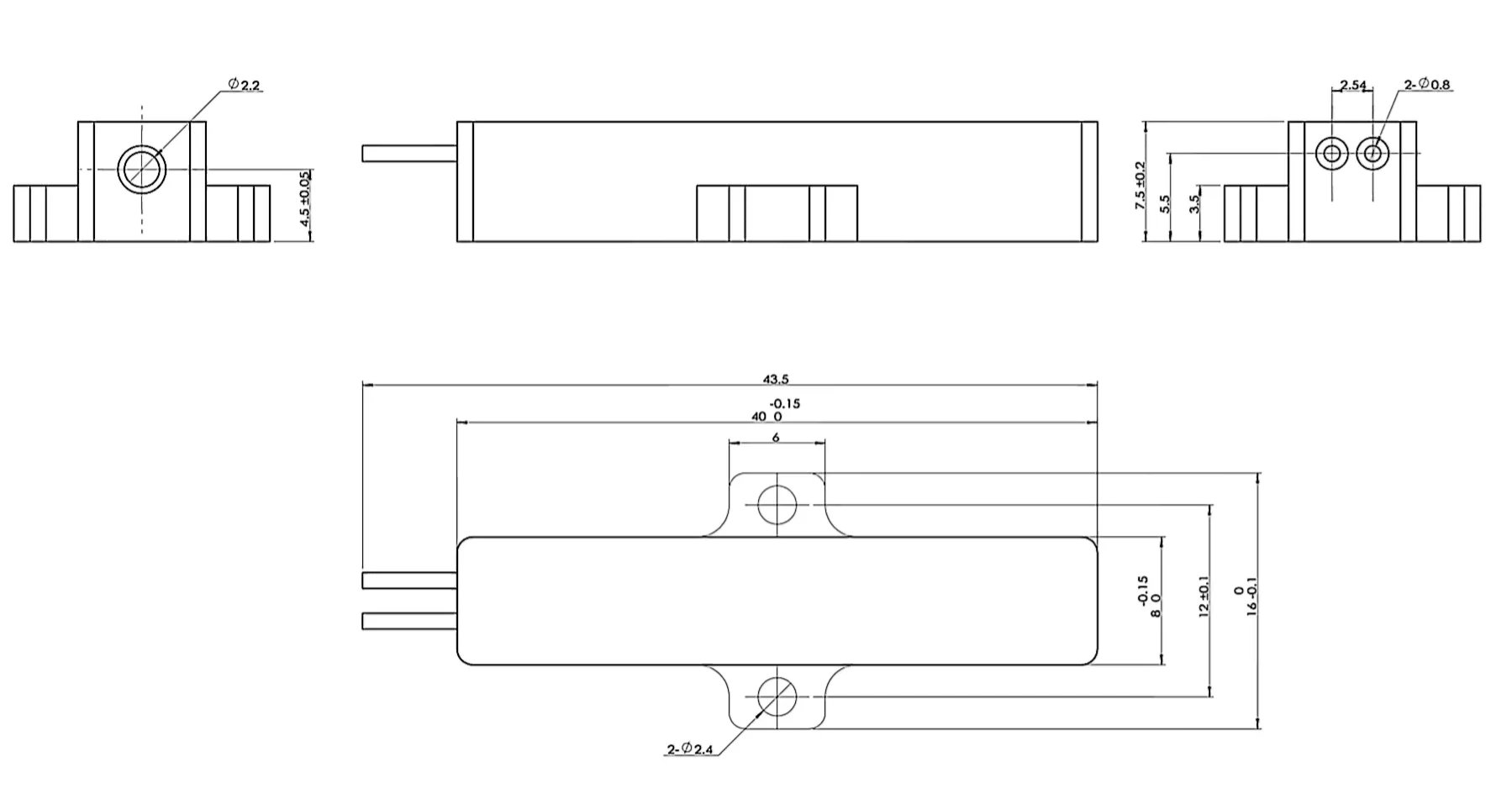
The technical material below is retained for this model only. Do not transfer a range, pulse, interface, mechanical or safety value from another 1535 nm product.
Specifications
ER900 is part of the 1535 nm erbium-glass pulsed laser family. Its current PDF lists pulse energy ≥900 μJ and optical pulse width 7 ns. Repetition-rate status is shown separately in the table. These are the source's distinct specifications; none establishes the distance or accuracy of a finished instrument.
| Parameter | Current PDF value |
| Model |
ER900 |
| Laser Wavelength |
1535nm |
| Laser classification — source entry |
Class 1 (classification report and evaluated configuration require confirmation) |
| Pulse energy |
≥900 μJ |
| Laser Pulse width |
7 ns |
| Drive pulse width |
≤ 3 ms |
| Pulse repetition rate |
1~5Hz |
| Pulse stability |
10% |
| Raw Beam Diameter |
0.3 mm |
| Beam divergence angle |
≤ 7 mrad |
| Beam Mode |
TEM00 |
| Operating temperature |
-40 ℃ ~ +65 ℃ |
| Storage temperature |
-55 ℃ ~+ 75℃ |
| Dimension (mm) |
40×8×7.5mm3 (Three linear dimensions in mm are listed; the source’s mm³ typography is not a calculated volume.) |
| Weight |
18 g |
| Voltage |
2 V |
| Electric current |
30 A |
| Shock |
1500 G, 0.5 ms |
| Vibration |
20~2000 Hz/20 G |
| Lifetime |
>1million shots |
Source-version clarification
Storage temperature: the current PDF table gives −55 to +75°C; its introduction gives −55 to +85°C. The table is displayed, but this individual limit is pending confirmation for the ordered version.
Reading this model's optical specifications
The recorded raw beam diameter is 0.3 mm and divergence is ≤ 7 mrad. The current specification table does not state the divergence's full-angle/half-angle convention or the beam-width measurement method. Those definitions remain unspecified until a beam report confirms them. The beam-mode entry does not, by itself, supply a measured M² value.
Values above were checked against the current model PDF, including its inequality signs and stated measurement qualifiers. Source entries of “Class 1” require the corresponding classification report; shock, vibration and lifetime entries likewise need their stated test conditions. Missing tolerances and statistics are not reconstructed from another model or a paper.
Outline dimensions