The technical material below is retained for this model only. Do not transfer a range, pulse, interface, mechanical or safety value from another 1535 nm product.
Specifications
ER100 is part of the 1535 nm erbium-glass pulsed laser family. Its current PDF lists pulse energy ≥100 μJ and optical pulse width 6 ns. Repetition-rate status is shown separately in the table. These are the source's distinct specifications; none establishes the distance or accuracy of a finished instrument.
| Parameter | Current PDF value |
| Model |
ER100 |
| Laser Wavelength |
1.54 μm |
| Laser classification — source entry |
Class 1 (classification report and evaluated configuration require confirmation) |
| Pulse energy |
≥100 μJ |
| Laser Pulse width |
6 ns |
| Drive pulse width |
≤2.4 ms |
| Pulse repetition rate |
1~10Hz |
| Pulse stability |
10% |
| Raw Beam Diameter |
0.3 mm |
| Beam divergence angle |
≤ 8 mrad |
| Beam Mode |
TEM00 |
| Operating temperature |
-40 ℃ ~ +65 ℃ |
| Storage temperature |
-55 ℃ ~+ 75℃ |
| Dimension (mm) |
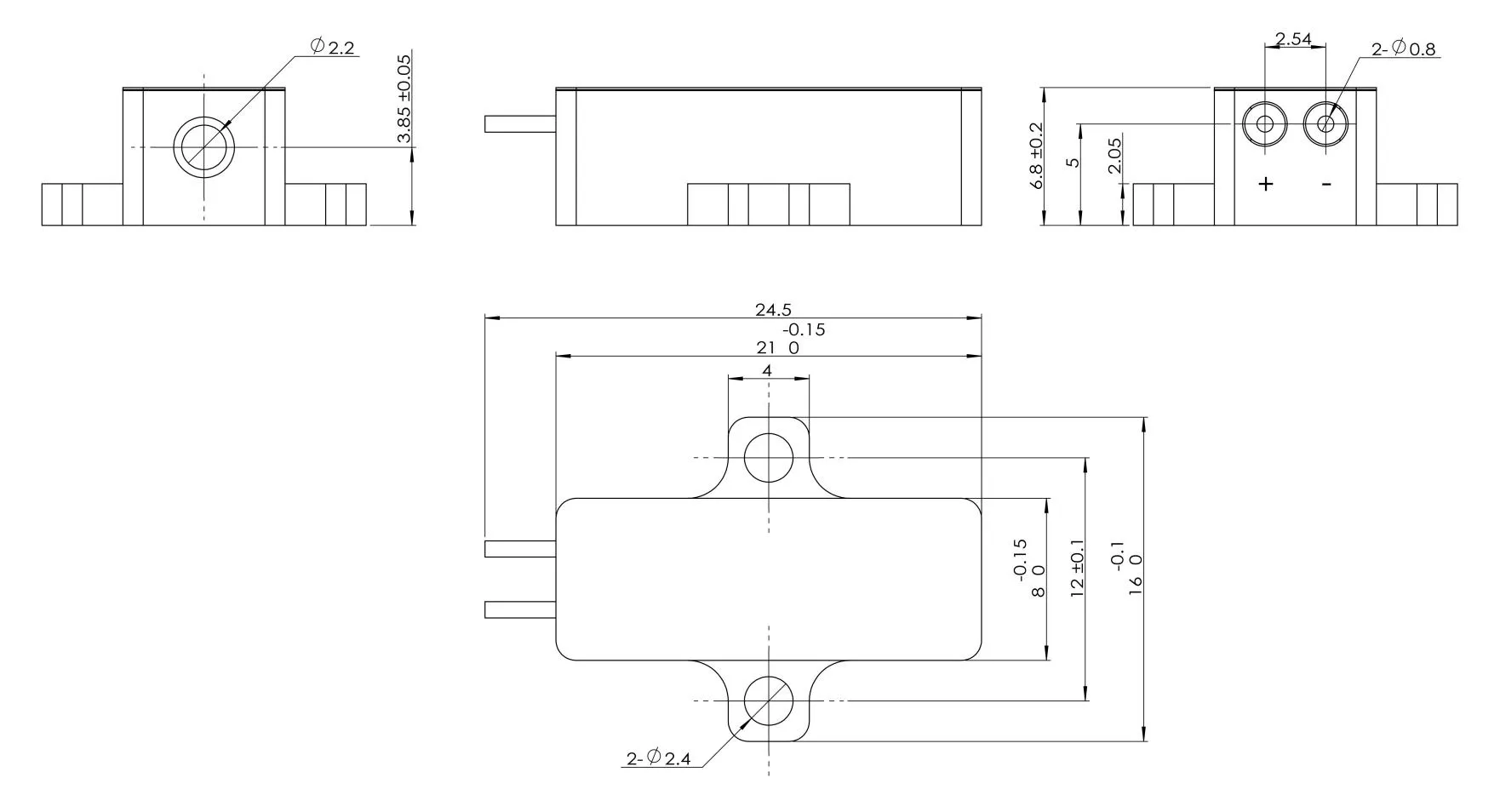
21×8×6.8 mm3 (Three linear dimensions in mm are listed; the source’s mm³ typography is not a calculated volume.) |
| Weight |
7 g |
| Voltage |
2 V |
| Electric current |
8 A |
| Shock |
1500 G, 0.5 ms |
| Vibration |
20~2000 Hz/20 G |
| Service life |
≥1million shots |
Source-version clarification
Lifetime: the current PDF table states ≥1 million shots, while its introduction states ≥10 million. The table value is displayed; the ordered lifetime rating needs confirmation. No 10-million-shot rating is asserted here.
Reading this model's optical specifications
The recorded raw beam diameter is 0.3 mm and divergence is ≤ 8 mrad. The current specification table does not state the divergence's full-angle/half-angle convention or the beam-width measurement method. Those definitions remain unspecified until a beam report confirms them. The beam-mode entry does not, by itself, supply a measured M² value.
Values above were checked against the current model PDF, including its inequality signs and stated measurement qualifiers. Source entries of “Class 1” require the corresponding classification report; shock, vibration and lifetime entries likewise need their stated test conditions. Missing tolerances and statistics are not reconstructed from another model or a paper.
Outline dimensions